Thursday, April 16, 2020

8+ days on the Iditarod Trail: Part Three

Alabama Bumble Snow Monster.

McDougalls to Shell Lake: ~101 miles, 2 days 16 hours

I awoke to my phone alarm after a few hours of blissful and deep sleep. I was all warm and happy but hungry! I wish I could lie there several more hours but I needed to get moving. It was getting close to first light and I'd planned for a big push all the way to Shell Lake, some 30+ miles away. This could take well over 15 hours if all I could do was to continue plugging away at 2 mph moving pace.  I also planned to make a quick stop about half way at the Skwetna Roadhouse where I'd finally be leaving river travelling behind for a while. So, I had to get going if I wanted to make it to Shell Lake at a reasonable hour without having to travel completely through the night.

So I quickly collected my now dry gear and packed it away as quietly as I could as the two others upstairs with me were still asleep (or nearly so). I then re-donned most of my base layers, finally changing into clean and dry socks for the first time! Ahhh! Nothing like a fresh pair of socks even though they'd be wet soon enough! More on this topic later... this would be a constant struggle! I crept downstairs with my arms full and quickly shuffled out the door and the short distance back to the main lodge.  It was a beehive of activity inside. I think everybody had the same idea; winter race logic. Time to move on! Several bikers and foot racers; some who'd been ahead of me and several others who'd slipped in behind me in the night. The hostesses were amazing! Serving up yet another hot meal and coffee! COFFEE! But before breakfast I had to use the facilities and to my amazement when I asked where they were, expecting to be directed back outside to an unheated outhouse, instead they said oh you can use the portable toilet upstairs! Not quite a flush toilet but, real TP in a warm space? Wow! To my great regret, I didn't realize until far too late, that showers were fair game! Doh! That would've been amazing!  Anyhow I went back downstairs and stuffed my belly yet again with some good grub right along with half a dozen or so other racers.

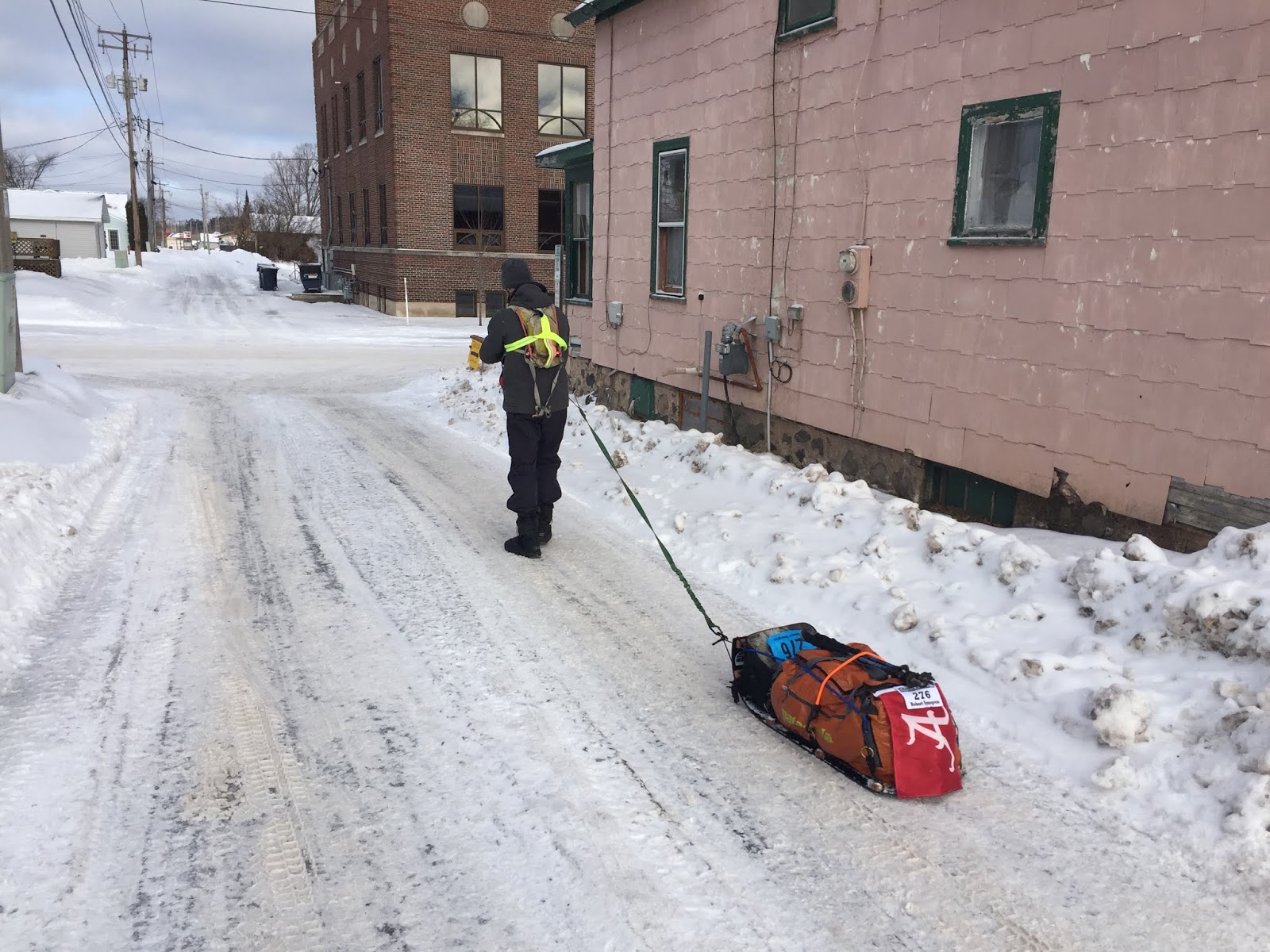
Nobody seemed in any particular hurry to get back out there, myself included. But, I'd had an epiphany that morning (see sleeping a bit more does have it's benefits!) that perhaps the way I'd always been loading up my sled was flawed. That the load was unbalanced in such a way to cause me great angst!  Sure enough, now that I finally actually STUDIED how my sled was typically packed up I was way to forward heavy; I was causing my sled to dig more into the snow as I pulled. No wonder I'd been having issues. Issues not only at this race but in ALL my previous winter races when I used a sled! I'd not been storing all my water containers at the very front of the sled, this typically amounted to at least 3-4 liters inside HydroFlasks or other heavy insulated containers. I also had most of my foot upfront. The middle portion of the sled was typically all my clothing with the most likely to be needed stuff towards the top and the lesser likely stuff in various strata below all the way to the bottom. Back end of the sled was pretty much one giant packed down dry bag containing my entire bivy system: MSR waterproof bivy sack -> Klymit insulated inflatable pad -> Mountain Hardware Lumina -30F bag. Yeah, pretty dumb right? Easily the heaviest stuff was right in the forward 1/3 to 1/4 of my sled! So I was in no rush to get out of there, instead I put on a bunch of layers (over dressed) and went out to my sled with all my dried out gear and basically dumped my entire sled bag out onto the covered porch. I then carefully re-packed the sled bag with the heavier items toward the middle 1/3, i.e. my insulated bottles and insulated soft ice-chest along with all my food. The big dry bag still stayed in back but now my extra layers of stuff moved more forward but the heavier, bigger items found a place in other nooks and crannies further away from the front.  Once I was finished I could tell a big difference just picking my entire sled up from either end. It felt more balanced, that the center of gravity was definitely in the middle now! Damn I'm dumb! I've got a Ph.D. and it's taken me how long to figure this out? Well, that is one of the downsides of doing these winter ultras coming from Alabama, I don't have many opportunities to test gear or gear setups! No excuses though, I should've figured this one out a long time ago!

Now I was actually excited to get going. Not that I wanted to leave The McDougall but I couldn't wait to see if my sled re-balancing actually worked.  In short. Yes it did. Amazingly so!  Anyhow, I ended up heading out just ahead of the other racers I'm pretty sure; some might have slipped away without me noticing, it's honestly a bit of a blur at this point. I'm trying to document what I remember! It was pretty cold that morning and respectable headwind to boot. But after just a few miles out it began to get lighter and lighter out with the rising sun. Still very cloudy, but not near as socked in as it had been the last couple of days. The trail was firm enough to go without snowshoes so I took advantage. That is possibly, in my mind, the only real benefit of travelling overnight is that the colder it gets the more likely what soft trail you had will at least "set up" or firm up enough to allow easier travel. It's a fine line though, too cold and the snow can obtain a gritty texture like sandpaper that makes dragging a sled much more difficult.  But just being out of snow shoes would be a huge plus; almost enough to convince me to try going through the night some more. Naw, just kidding. Night time is for sleeping!

The other big reason to travel over night is the lack of "civilian" traffic to mess up the trail, i.e. snow mobiles. Note: I honestly have nothing against snowmobiles or snowmobilers; I've spent a healthy amount of time snowmobiling myself in Colorado; it's good fun and an essential tool for survival in the Alaska Wilderness. What follows is more of rant about things one cannot control in a shared use space. Please no hate mail! This is just an observation from the point of view of a human powered athlete along a winter trail. You see, snowmobiles are the Good Cop - Bad Cops of winter ultras. When there is NO TRAIL to speak of, passing snowmobiles are the Good Cops, "here buddy, let me pack down the snow for you, is that better? Great!". In this case it makes your progress easier; instead of having to break trail and post hole like crazy, suddenly you have a trail! Yippee! Now, unfortunately there is a Bad Cop side of snowmobiles. Yes, sometimes you're rocking along at 3-4 mph on a nice firm trail, snowshoes all packed away, High Plains Drifter blasting in your ear buds when all of a sudden you hear that distinctive engine whine from behind, or you see the twinkling of a headlamp far ahead of you. And then, you think to yourself or downright curse out loud, "Aw *uck!!!" So you carefully step aside to let the snowmobile(s) (there's always more than one) by; hopefully it's not too deep on the side of trail but it usually is and you end up post holed up to your waist.  You fake a smile and wave or even flash a thumbs up, even when you'd prefer to flash a different finger.  That beautiful trail is now a soft, chewed up mess. Bad Cops. "You think you're something special? Hiking out here on our turf? "Ididiots!" Now let's see how fast you can hike!" And away they go... Early on during the ITI I still had a lot of optimism. Perhaps the trail won't be too soft and chewed up? Maybe it won't be bad? So I'd try and hike it some more and end up cursing some more and stopping to put on my snowshoes. Well before halfway through the ITI I didn't even bother, I'd just put on the snowshoes almost as the snowmobiles passed by, or at the very least put on my over-boots (more on that later). Let's just say there were plenty of Good Cops and Bad Cops out there. Stay tuned, there is an incredible Good Cop story coming...

Typical soft mushy snow track. Bad Cop.
But traveling during the early morning hours is often just as good as travelling overnight. I at least would typically have several hours before there would be any snowmobile traffic. The further I went in the race the less and less traffic I'd see all day long. The would come a time when I wouldn't see another human being all day!  But this morning I made pretty good time but was definitely fighting some headwind. Early on I spotted another moose and this time I had my phone out ready for the photo. You'll have to trust me on this, but that is a moose dead center in the photo below.
Dead center, resting moose at a "safe" distance away.
This moose was resting; sitting in the snow. They had the right idea!  I can fully relate how tiring it is trying to move through deep snow! Finally got my first views of if not the Alaska Range itself, at least the foothills leading to them. This meant my time on the Yetna river was drawing to a close!
First glimpse of mountains in the distance, along last bit of Yetna River.
As the morning went on and the wind really picked up, I was again finding blown in trail to enough of a degree that I eventually succumbed and put snowshoes on.  The trail was softening some as well and snowmobile traffic picking up just made it more obvious to keep the snowshoes on; probably for a long while yet!  But this is typical for winter river travel on foot; the snow tends to not ever really pack in super well as it can endure a lot of cycles of heating/cooling day/night cycles as well as fresh snow blowing in.  Many more reasons for wanting to get off the river! But the biggest was to finally get back into the woods for a little more wind protection!  As I drew closer to the foothills, I got rocked several times by some pretty strong sustained wind gusts. No telling what those windchills were! At least it was daytime, but wow I was almost knocked off my feet a few times! Finally, off of the main branch of the Yetna I snowshoed right on up to a sign indicating Skwetna Roadhouse was only 4 miles away.

Getting close to the next checkpoint! Sure felt like further than 4 miles however!
Just past the sign I dropped onto the river again, this time it was probably the end of the Skwetna River itself where it joins the Yetna. Turning to follow the trail markers put me right into the ugly teeth of some pretty remarkably strong wind! Luckily I got through this stretch fairly quickly and was now winding around some narrow but majorly ox-bowing river sloughs that ultimately led me off the rivers for good and on a well broken in snowmobile trail (road) leading straight to the road house. Just as I was about to leave the river I heard plane engines roar to life and I just had enough time to dig my phone out and catch a video as the small plane flew right over me.

Plane taking off from Skwetna Roadhouse.
About a mile later I arrived at the Skwetna Roadhouse. There was still a lot of daylight left as it was about mid day or so. I pulled my sled right up to the front porch and joined a few racers inside including Lars Danner who was attempting to ski to McGrath after having successfully covered the same ground in prior years on both foot and bike. If he made it to McGrath this year he'd be the first person to have completed the ITI 350 A'trois (finish in all three disciplines). His was also the GPX route a lot of us were using to navigate the course. I'd communicated many times with Lars in the weeks leading up to the ITI; he was always super helpful and more than willing to share his vast knowledge of the course and winter adventuring. Thank you Lars!  We chatted a bit while we both eat big lunches. I noticed I had cell service and 3G so took the opportunity to upload some photos I'd taken and to call my wife at home. Was so good to hear her voice!  I kept the call short as I really needed to be going. So after my meal and settling up my bill I was back outside loading my gear back up, harnessing in and was off!
Skwetna Roadhouse at last!
I had little difficulty finding the correct way out of Skwetna and back onto the Iditarod Trail; others weren't so lucky.  Turns out we actually left the Iditarod trail for a brief time to cut over to the roadhouse and had to follow another connector trail back to the Iditarod trail. Some folks ended up back tracking or following some other entirely different route. I think I just got lucky or ended up following somebody else's tracks. As I walked along, trying to allow my stomach time to process, I started to think about my plan ahead.

Leaving Skwetna in the afternoon.
I was now in a good position to finish the race easily within 9 days. The cutoff is 10 days and each check point along the way had some intermediate cutoff as well, some number of days. Even as slow as I was going I had a lot of time, even if I had to take A LOT of down time. When you consider the foot record is just over 4 days you wonder why 10 days are allowed at all? They've had years at ITI where they had a 100% finish rate! When's the last time you heard about an ultramarathon having a 100% finish rate? Well those were in good years when the trail was completely snow covered and firm and no snow storms during the race and it didn't get brutally cold. So everybody was pretty fast across the board. This was not going to be a year like that. In fact there were already many racers who'd dropped out and some who'd be fighting to make it to McGrath within the 10 day cutoff! So yeah, I get it now!  Anyhow my plan was try and spend each night at a checkpoint from now on with the exception of the long leg between Rohn and Nikolai which is at least 75 miles (could be a lot more...) in that stretch I'd most likely have to bivy or make it to a small shelter cabin about half way.  This would set me up for one final push from Nikolai to McGrath which is at least 50 miles; a long way but it would be the LAST 50 miles and worth pushing through in one shot. I was a bit over 2 days into the race so, literally counting the race days out on my fingers I came up with the super conservative plan. Day 2.5 Shell Lake, Day 3.5 Puntilla Lake, Day 4.5 Rainy Pass Lodge, Day 5.5 Rohn, Day 6.5 The Burn Bivy or Shelter Cabin, Day 7.5 Nikolai, Day 8.5 McGrath. That left me a full day and half of buffer ahead of the finally cutoff.  As I was working this out, counting fingers in front of my face, Lars came skiing up and chatted with me. I explained to him my plan and he said it sounded pretty good to him as it pretty much matched up with what he was planning. Cool! Lars steadily glided away from me on the long straight, well plowed snow road.

The "road" out of Skwetna, finally some firm ground (temporary).
-Late afternoon on the swamp, audio book and tricky intersection, steep uphill!
The snow road was nice. I was almost even able to run (I'd left the snowshoes strapped to my sled) a bit (well, I had to try!). But soon enough the road petered out and I could hear the wind ahead of me picking up steam. It was an odd experience just standing there at the very end of the snow road; still protected by the thick tree cover on either side. On the verge. As soon as I would walk not even 20 feet out of the treeline I would be whipped by the katabatic winds racing down from the nearby mountain range. I could see (in the picture and video below) the wind literally working its best to bury the trail by blowing loose snow onto it a process typically called "blowing in" or after the fact "blown in". This would happen quite a lot over the remainder of the race. With the hard winds and loose snow abounding trails would frequently disappear almost right before my eyes! In fact after I'd paused to add a wind layer and strode confidently into the gale, I could barely see Lars's ski tracks right underneath me even though I could still see him in the distance. Crazy!
The beginning of the endless swampland after Skwetna.
That wind!
I'd spend the next several miles crossing from one end of this frozen swamp to the other. I only was passed by a couple of bikers (who were at The McDougall that morning) right as I began across but they unexpectedly turned back around and passed me back. The said they weren't sure about continuing on as it looked like they were going to have to push for a really long stretch ahead.  It's got to be demoralizing to be a biker this year when you're only way forward is to push this big heavy beast! I'm not sure I could do it! Kudos for them for trying. I'm pretty sure they both were multi-time finishers of not only the 350 but possible the full 1000 as well. Yeah, the trail really started to get blown in after I continued on. You guessed it, soon enough I was right back into snow shoes. I had not choice this stretch of trail was now buried under several inches of snow. And, yeah, not long later there was enough snow mobile traffic to at least re-open the trail but now it was a soft, churned up mess.  So yeah, snowshoes for the win!  Still, with views like the following series; a Christmas card photo everywhere I looked who could complain?


As I steadily worked my way across the long expanse, soaking in the beauty of the late afternoon lighting, I decided to finish up an audio book.  With no navigational difficulties for a while and wide open enough terrain with which to spot oncoming snowmobiles it was as good a time as any.  Also, my heading had changed to put the fierce wind at my back so it was now just a pleasant snowshoe stroll with the pre-Spring sun still seemingly providing some warmth on my face. 

I almost never run/hike with music or any distractions. I listen to mostly electronic/synth music all the time while at work as a computer scientist-analyst but there it helps keep me focused.  Out running is my chance to be free from the distractions of technology and electronic devices (for the most part); I relish the opportunity to hear water flowing in creeks, wind through the trees, birds chirping... But I was also getting a bit sleepy so having an audio book distraction was in order. And any audio book narrated by R.C. Bray is highly recommended! I highly recommend  the Expeditionary Force series by Craig Alanson if you're into sci-fi like me (it's about all I've enjoyed reading and listening to since I was a teenager).  Anyhow the shadows grew longer and longer and soon enough I'd reached the far tree line and entered the shadows once again.


I snapped a quick photo looking back the way I'd come; marvelling at the peacefulness of the moment. Since Skwetna this was the longest stretch I'd gone without seeing anybody.  It was wonderful!


But now I was back into the woods so no more audio book! It was time to be on high alert as in these close quarters and in the evening twilight there could be moose roaming about.  Sure enough i was yet again seeing moose tracks on either side of and on the trail. They had to be fresh. I was starting up a rise in the trail when I heard the sound of several snowmobiles ahead of me.  I stopped and pulled my sled and myself off the trail as best I could. Even here the trail was still marvelously trenched out and it was difficult to leave enough room for a snowmobile to pass.  A large pack emerged from the dim forest trail moving relatively slowly. The leader held up a hand as he drew near me and they all slowed to a stop. As he pulled up next to me he stopped long enough to tell me that just up ahead was an intersection and that I should go to the RIGHT. I thanked him and he was back on his way along with the rest of the following group. They had Iditarod vests and gear on so perhaps they were trail breakers? Not sure. Anyhow at the top of the small rise I did indeed come to an intersection in the trail.  It was good I'd gotten that trail tip, even though I had a navigational device with me, I might not have checked it and just plodded on straight ahead as the route looked like it would bend around to the right which is exactly what the zoomed out version of my map looked like my track was supposed to do. Instead I turned right and began hiking up an extremely steep series of hills. The following picture doesn't do it justice but it was like I was climbing up a steep bobsled course. Relentless and the walls of the "chute" were sometimes almost head high! Unbelievable amount of snow! I was secretly hoping we'd have the same bobsled run on the far side of the hill so I could ride my sled down!

This was probably one of the only times I was happy to be in snowshoes as the tungsten spikes really dug in and provided ample traction. Not sure I could have dragged my 50lb sled up these steep hills as easily without them. Up and up I climbed. Every time I'd think I was near the top there would be more climbing. WTF? Just when I'd finally given up hope I hit the summit with barely enough light left to see.  Quick aside about available sunlight and available light this time of year. While sunrise was around 8 a.m. and sunset around 6:30 p.m., the really need thing was that at this high latitude the angle the sun made across the sky was very shallow; not straight up and down. So there was actually navigable light a full hour before sunrise and a full hour after sunset. So, even though it was Winter (barely) we had almost 12 1/2 hours of usable light every day to travel by. Kinda neat and something I didn't honestly figure out until I was Out There.

Before heading downhill I stopped to dig out my lighting system which I haven't talked about but were a couple Lumen 115 Clip Lights made by UltrAspire. I went with these because they only take a single AA battery each and use a magnetic clip system so they can be attached almost anywhere. I've grown to loath using a headlamp so instead I would clip both to the sternum strap of my backpack and just use one light at a time for normal usage or both if I really wanted a lot of light. For winter ultra travel on snow, and with the often abundant moon light it's not necessary to have a ton of battery killing lumens. The only thing I messed up with was not bringing Lithium batteries. Big mistake. While I would get decent battery life on the warmer nights (during the early days when it was in the 20s Farenheit) by the end of the race, past the Alaska Range, I was killing batteries quickly! Whoops! Luckily I had packed more than enough batteries!  Anyhow, as I was adding a layer and sorting out my lights, the Kiwi bikers caught up to me. George and Graham. Two of the nicest fellas you'll ever meet. They're joy and enthusiasm, in in extremely adverse conditions, is contagious! They were multi-time ITI veterans and were attempting the 1000 mile this year. They always took things in stride and never got bent out of shape. They'd ride or push until they got tired and took long rest breaks. All about pacing themselves and enjoying the full experience as much as possible. So, we woulds start to get in this pattern of me leaving out ahead of them every day only to get overtaken by them at some point. I never knew when I'd see the pair next, but I knew I'd always see them at some point that day.

George and Graham paused to chat. They confirmed that we were only a couple miles out from Shell Lake. Yippee! Unfortunately I wouldn't have the bobled run I was hoping. I'd climbed up to a high plateau so there'd be no wicked downhill but for a couple of fun stretches. That was the Iditarod trail for you, so full of hope and promise only to be left disappointed at times. Bait and switch all the time! At any rate soon enough the trail emerged out of the woods an onto a small lake, Shell Lake. The bitter cold and wind hit me nearly simultaneously.  In the woods I'd sort of thermally stabilized so dropping onto that exposed lake must've dropped 10 degrees or more in temperature not even counting the gusting head wind! But, I could see the blinking red light in the near distance; I was close! And after only a half mile more I was there. Shell Lake Lodge. Not an official checkpoint but a trail angel that the race utilizes by renting out small bunkhouses.

I pulled my sled up a very steep hill leading off the lake to the lodge then parked it next to a score of other sleds, bikes and skis. Damn, I think the entire race field was here! Sure enough the lodge was still a busy place, even after midnight. There was Beat, long time ITI veteran, about to head back out into the night. He was aiming to make it to Nome for I think the seventh time! Incredible! There were a bunch of my midwest winter ultra friends there as well. Faye and Jeff looked to be getting ready to head out again. This was also a recurrent pattern. I'd arrive at a check point just as they were about to head out. They were full on race mode!  I dropped my gear in a corner and ambled over to the bar and ordered a meal and Coke. It was a cozy little lodge. Was good to see so many folks. But I needed to get to a warm spot and sleep. I devoured my food and drink and asked about lodging. The caretaker said that there were 3-4 cabins not far that were rented out for the racers; I only had to find one that had a free bed.  I learned from the other racers in the lodge that first cabin had a couple bunks available.

So, I paid for my meal then headed back out into the wind and cold to find the bunkhouse. It was pretty easy to find and I was quickly inside out of the cold. It was a very rustic and tiny cabin; but practically a room at the Ritz Carlton as far as I was concerned. There was a bunk bed to the left, occupied by a single snorer, and right in front of me an unoccupied double bed! What unbelievable luck! I hung out my damp gear to dry and set my boots on the ground near the wood burning stove to dry. This turned out to be a rookie mistake as the ground level was still pretty much close to freezing so they never dried out!  You see, there was also a draft in the room from the door not closing all the way to begin with and after a racer looking for a place to sleep "accidentally" left the door partially open when they moved on, disappointed to not find an open bunk I'm sure. Didn't realize that at the time, only thought, damn it's getting cold in here and the stove is stoked up! So I would be very disappointed myself when I woke up the next morning and began to layer up only to find my boots nearly frozen! But, at the moment the stove was going pretty good but I'd have to remember to stoke it later on by adding another log. I laid out my sleeping bag (not wanting to disturb the bedding), plopped in my ear plugs (good pro-tip from some prior ITI veterans) and was soon fast asleep, visions of sugar plums dancing in my head! Just kidding, I don't even know what a sugar plum is? I don't think I dreamt at all during the ITI; these were hard, fast and deep, lights off, coma-like sleep sessions. Restorative but not restful.  I'd need to be restored because these next couple of stretches would prove to be a big test for me. I thought I'd had it tough so far? I'd seen NOTHING yet!




Monday, April 13, 2020

8+ days on the Iditarod Trail: Part Two

Lonely trek along the Yetna River between Yetna Station and "The McDougall". Courtesy of Amber Bethe.

Near the Susitna River to McDougals: ~70 miles and 1 day 15 hours elapsed time

It was around 5 a.m. completely dark and amid a flurry of falling snow I rushed to extricate myself from my bivy (still fully clothed included my boots), pack up and go. I was half awake, sore and clearly still feeling very fatigued after not even a day into the race! Ugh! I'd poorly prepared my bivy spot; all around me was deep snow and I'd failed to pack it down enough to provide a firm and stable platform.  So now, as I raced to pack my bivy back up into the dry bag I continually post holed up to my waist in the snow and had to carefully pull my self back up out of the hole. The upside was all this activity warmed me up and I was soon back on my way.  I think I did get at least a couple hours of reasonably solid sleep, although I do recall hearing at least a couple foot racers pass me by in the night.  But as it'd been snowing fairly heavily, their tracks were gone; replaced by unbroken trail with least a few inches of new powder.  So, right back into snow-shoes!  My goal had been to bivy in the last bit of woods before committing to dropping onto the Susitna River.  The reason was simple; wind protection. One of near constant companions on the trail is the wind; sometimes barely there, sometimes near gale force in your face; but always around.  So in the woods provides one some degree of protection. Also, typically dropping onto the frozen rivers one also experiences a significant drop in temperature as well; it's generally a big "no no" to try and bivy on the river; cold, windy and so exposed; not to mention the real threat of getting run over by a passing snow mobile. So my bivy location ended up being pretty close to river; I only had to hike another mile or so before I emerged out of the woods and dropped down a steep section of trail to the river.

Almost immediately I saw a line of moving lights in the distance (on the other side of the frozen river), travelling from my left to my right. Bike lights.  Wow! This was my first indication that this was going to be a tough and slow year. Usually the last time time foot racers see the bikers is there distant backs as they fade in the distance right after the race start.  To still see bikers at this point meant they'd been pushing their heavy steeds more than riding them.  A biker pushing their bike is, for the most part, slower than a foot racer dragging a sled; there are exceptions of course but that's a general rule.  From the rate the lights were moving though, this group of five or six bikers were riding; they'd found some solid trail!  That was good news for me as well as it looked like my route would converge with their route in short order.  As happens sometimes at this race, there are often alternate routes the one can take that may be longer but could prove to be easier terrain, i.e. avoid some hills, soft snow, avalanche danger, etc...  This was what I was seeing here. Looking back at the GPS tracks after the race one could clearly see most or all of the bikers ended up following the snow-mobile track advertised by the Good Samaritan I mentioned in Part One.  Apparently it must not have been all rideable as the bikers would have been long gone; or perhaps they'd simply decided to bivy early like I had? Who can say.  I'd guess that they all bivied for a few hours like I did as I'm sure they were already making pretty slow progress in the snow storm.

Quick aside. It's worth mentioning that at the ITI, all one's route choices are completely optional; the only requirement is that racers must pass through specific check points and sign in and out. How you chose to get there (under your own power of course) is completely up to you. This year, with the heavy amount of snow and the fact that the trail would mostly be a deep trench through it, route choices were few. However, in other years, particularly low snow years, the route options might vary. It's because of this high variability of route choices that the total race distance can vary from person to person year to year. Although advertised as 350 miles, most years it's no where near that number; much shorter. If I had to estimate I'd say it's definitely more than the 299.7 miles I got credit for on the Track Leaders website; probably close to 320-330 miles.  The reason being, these Track Leaders distances come from the accumulation of GPS tracker measurements at 10 minute intervals from each racer.  I know for a fact most of those straight line parts on the tracking map were far from straight and far from flat; lots of twists and turns within that 10 minute period that aren't indicated on the map. Also, just based on some short sessions when I'd turn on my personal GPS watch just to get a bead about my pace it was easy to estimate average pace and look at how much moving time I had for the particular day and estimate that way how far I'd traveled. Adding all that up gave me around 320 miles give or take a mile. 

The bike lights slowly faded away to my right as I continued to slog through the soft snow towards the other side of the river.  I was so hopeful that when I reached the other side that I'd find a well worn snow mobile path which is surely what the bikers were following.  Sure enough my less trodden path soon merged onto a much more firm path. It was a thin white line to be sure but it was, for the moment, the best packed trail I'd seen since the first few hours of the race. Since I could no longer see the bikers I took that as a good sign that the firm line continued for some distance so I took the opportunity to remove my snow shoes and stow them, strapped to the top of my sled. It was still pre-twilight but past the witching hours for sure, even my rough sleep was enough to revitalize me.  The best part was it had stopped snowing! So I hiked on for a while hoping the path stayed firm enough to stay out of snow shoes. In this time another biker caught up to me and passed me by. I tried to pay close attention to where he went because I found that there were indeed a few different lines to follow at this point.  Frozen rivers during the winter in Alaska are prime time "highways" for snow mobiles that travel to and from everywhere to acquire goods and services, make treks to visit neighbors or just to head out for a long cruise.  As such while there was typically a fairly dedicated line for snow mobiles there would often be other well worn tracks leading off in other directions.  So it was important to pay a bit more attention to where I was going. My immediate goal was to head upriver on the Susitna and eventually slit off to the left to head up the Yetna river. Sounds easy enough but it was still dark and this was a really big river I was on and there were all sorts of little islands and sloughs that could easily be the way to go. But continual checks of my GPS showed I was going in the right direction.

After another hour or so of good hiking, the sun didn't so much rise as it just got light enough to not need my headlamp any more such was the cloud density.  But now the light was so flat it was often difficult to pick out the firm line; I'd only realize I was off of it when my feet would post hole!  This would be a common theme throughout the rest of the race during daylight travel on the various rivers we'd follow.  I was now approaching the Yetna river according to my GPS although it all looked the same to me; difficult to discern a difference in the terrain.  I'd also sort of caught up to that large group of bikers who had stopped to take a break, adjust tire pressure, etc...  They were still a little bit ahead of me but I'd definitely made up some ground.  This would also be a common theme over this day, I'd see this group or another group of bikers fade into the distance while I kept marching on but then I'd eventually catch up quite a bit; almost close enough to be in yelling distance but then they'd saddle up and disappear again.  Sometimes they'd take longer breaks and I'd actually pass them by for a short while until they got going again and left me behind.  Still, it was good to see other racers throughout the day as it was mentally challenging hiking along the river with huge site lines; felt like I wasn't getting anywhere; nothing seemed to get any closer!  A couple hours after sunrise I caught up to the foot racer from Indonesia, Hendra.  Hendra was stopped on the side of the trail melting snow with this stove.  I kept going but just a couple hundred more meters when I thought I could use some coffee and some more significant calories. So I figured why not stop and go through the motions of getting the stove fired up and melt some snow while I was at it as while I wasn't low of water, my progress looked to be pretty slow enough that I would need some more before I reached the first check point still some 30 miles away. Long story short it was a good thing it wasn't too cold out at the time (probably mid 20s Fahrenheit) because I fumbled around for way too long trying to get the stove going, melting snow (damn it's a slow process melting snow and it takes A LOT of snow to properly fill up any container).  But in the end I was successful if a bit chilled from stopping a bit too long.  Yeah, sure enough just as I'm finishing up preparing my back packer meal it starts to snow again! Great! I hurry to cut off my stove and carefully pack it away and get going again.  Boy that instant coffee was awesome by the way! Really highly recommend the Nescafe Hazelnut.  

The snow continued to fall fairly steadily and soon enough I was starting to have trouble finding a firm enough trail so about the time I was solidly onto the Yetna I stopped to put my snow shoes on once again.  This was one thing I'd struggle with throughout the days, when to put them on and when to take them off. I think I was most reluctant to stop and sometimes stubbornly kept going despite difficulty far longer than I should have. The snow shoes I honestly only brought with me "just in case", I never figured I'd be using them at all, let alone for most of the race!  I'm not a snowshoer. I would be but we don't get many opportunities in Alabama...  The pair of snow shoes I have were a pair of Red Feathers I bought many years ago just to play around over the winter holidays in the San Juans of Colorado. They are sturdy shoes but heavy and cumbersome to put on and take off. I began to have some serious snowshoe envy after a few days on the trail; watching how easily the other foot racers got into / out of their snow shoes and boy did their snowshoes look light! Oh well, use what you got right? Nothing to do but head on upstream. So that's how I spent most of that day, just hiking into a steady wind aiming for an outpost somewhere upriver. The snow finally stopped and the sun came out of hiding; the storm was finally past! It was a long day on the river. Around every bend I thought I'd be there.  I know I had a long way to go and tried to avoid looking at my GPS overly much as I really didn't want to know how far I had to go to the checkpoint nor how slow I was going.  With the sun out it made it even warmer out and the snow even softer making it more and more difficult to drag the sled behind me. The way other foot racers just blew by me, it started making me think that perhaps there was something wrong with the way I had my sled packed and balanced. Gave me a real complex and something I started to really think about.  But in the middle of the river was no place to stop and repack. Time enough for that later. 

After several boring hours hiking along sometimes good trail, sometimes soft snowmobile churned up trail I finally arrived at Yetna Station sometime around 4 p.m. or so I believe. Still daylight. I was so looking forward to getting inside, eating a big meal, setting my sleeping bag and wet layers out to dry and getting in a solid few hours of sleep. Unfortunately it seemed like a large portion of race field had the same idea. The place was packed full of gear hanging set to dry, racers taking up all available space to sit or sleep. Yetna Station is literally a family's home; very homely.  You literally open the door and enter right into the living room.  There was a baby crying in a rocker on the floor, a toddler and their mother donning snow boots to head outside, meal orders being shouted to the kitchen and zombie racers staggering around the too small place; a flurry of activity. I also learned all the available bunks were taken and I'd have to wait a while to get a place to sleep.  Clearly this was no place to stop, especially with no promise of rest and there being several hours of daylight left; I needed to keep going; make hay while the sun is still up. But what could I do? Bivy somewhere upriver I suppose. Not a bad strategy. I doubt I could hike the rest of the way to the next check point at the Skwetna Roadhouse without sleeping some more, but that was another 30 miles away.  As I sat the counter and ate my meal, fellow foot racer Daniel, from Australia, mentioned something about "McDougalls" being the new Trail Angel spot this year and it was only 12-15 miles up river. That peaked my interest, that was still in striking distance to get too before too late at night and sure beat trying to hang around this place. It seemed a sizable number of folks were actually scratching from the race and were awaiting a plane to come pick them up; bad vibes all around I had to get out of there! So I finished my meal quickly and joined Daniel outside as we both quickly re-packed our sleds (me with my still wet sleeping bag and clothes).  Daniel figured we were only 4 hours or so away from McDougalls. He asked what kind of hiking pace I was doing, 3 mph? I laughed and said I wish! Well maybe 6 hours or so for you? It is what it is, I was still thinking that there must be something wrong with my sled if he's yet another foot racer who seemed to easily march along at 3 mph or faster!  Anyhow, we donned our snowshoes and quickly put Yetna Station behind us.  

Watching Daniel steadily move away from me despite my best effort made it clear that I was in pathetic shape (probably not far from the truth) or my sled was clearly not pulling as efficiently as other foot racers I'd seen. But what could I do? I had no idea what could be wrong but whenever I really tried to stride out to achieve 3-mph in snow shoes I'd feel like my heart was going to explode with the effort. Ugh! So I'd throttle back into my typical 2.3-2.5 mph that seemed to be my peak normal moving pace in snowshoes. Damn why was I so slow!  

The shadows were really starting to get long now, only a couple hours left before sunset and about another hour of usable light after that.  Still, it was a fine time to be hiking along the Yetna. Absolutely gorgeous. It was around a couple miles out from Yetna Station when I spotted my first moose. Thankfully it wasn't close at all, not even close enough to attempt a photo with my phone sadly. It was on the far side of the river and sitting in the snow!  Now's a good time to mention that the biggest wildlife threat along the Iditarod are moose attacks. Moose are much more than very large cows as some racers described them.  The are also extremely lazy and irritable; especially in heavy snow years. Why? Well, getting late into the winter they are becoming very hungry and they don't like tromping around in the deep snow any more than we do so they, like us, tend to travel along the easiest way possible. Yes, moose like to use the same trail we're following!  And being irritable and hungry they don't take too kindly to others using the same trail.  We were told in the pre-race briefing that we would definitely have a moose encounter out on the trail. There were just far too many reports coming in of heavy moose activity all along the Iditarod trail between Knik Lake and McGrath for somebody to not have a run in during the race.  The RDs also said there is not much we can do other than to wait them out until they become disinterested and wander off the trail and back into the woods.  They said to not try and scare them or sneak by; that they will charge you, rake you with their antlers and then stomp you until your soft insides are a mushy pulp! Yeah, seriously, this were not the friendly kind of moose I grew up with in cartoons; no Bullwinkle! Doh! I'd heard a rumor of one racer's anti-moose strategy being to cover themselves with a white sheet (snow camouflage) and shoot bottle rockets at them! I'm not sure about the bottle rocket thing, but moose don't have good eyesight so I can perhaps see covering your sled and self with white sheets and sort of slink by... Then again the trail is not wide at all typically so would be nearly impossible! In a normal year you might could get by wading off trail and give the moose a wide berth with which to pass them by, but when the snow pack is over your head? Not happening. Sure enough there was indeed an incredible moose attack story at this year's race but we'll have to wait on that for another day (cue: foreshadowing). 

As the sun began to set the wind also really began to pick up in intensity. It also seemed as if the temperature began to plummet as well.  I'd been dressed in fairly light layers as it'd been so warm. I had to quickly zip everything up and add a layer and grab my face mask and goggles. The wind sure had some bite to it!  Now in the near darkness I began to regret pushing on from Yetna Station. I was getting very sleepy; it was getting difficult to keep my eyes open. It was a bit scary to be honest. I was feeling so exhausted and all I wanted to do was lie down for a few hours to sleep. But, yet again, I was in a bad spot to bivy.  It's a huge risk to bivy on any river, especially the Yetna. Not only is it really cold and exposed to the winds but snowmobiles travel the river at all hours (often at high speeds) and they could easily be on (and over) you before they knew it. And trying to get off the river onto land was a huge no-go this year with there being so much snow! It'd take a Herculean effort to try and wade ashore, up at least a short and steep river bank and into the woods. No way.  Luckily I've had similar experiences with the sleep monsters at more sane races and knew all I needed to do was really pack on the calories hard. So I forced down handful after handful of my own trail mix concoction (full of chocolate and peanut butter goodness among other salty and sweet things). That definitely perked me up but wow it was getting difficult to stay awake none the less and it wasn't even that late yet. Just a testament to how difficult it is to pull a heavy, possibly unbalanced sled in soft snow with snowshoes (at least for me) for mile after mile. At the time though, I was cursing my stupidity; that I'd ignored my race mantra of "make smart choices". The smart choice, to me at the time, would have to have stopped earlier to rest at Yetna Station. Now I had honestly no idea how far I had left to McDougalls and honesty if the place really even existed. Damn! It was honestly a bit scary, because I was still feeling a bit sleepy and didn't know how much longer I could go without having to stop but to stop now could be dangerous; that wind was really blowing now; enough to need wearing the face mask and goggles continuously. It was, ironically, one of those moments though when you feel powerfully in the present. Those moments when you know you are in danger. I was in no obvious danger, I had plenty of gear to keep me warm enough even through the night if I had to, but that's hindsight. I'd never been in a situation exactly like this and it, frankly, scared me. But all you can do is keep moving. That I know I could do if I had to.

After what seemed like an eternity, I began to see some flashing lights in the distance. And soon I was close enough to read a hand lettered sign next to the trail that said "Racers Welcome". It was around midnight and this must be the illusive McDougalls Fishing Lodge!  Splitting off the main trail the trail angels and constructed a path lit up by torches that led to the side entrance to the blinking lodge. YES! I'd made it. It felt like I'd crossed an ocean, weathering so many mental and physical hurdles since the race had started. But now it seemed as if I'd finally have the opportunity to get some real rest and food for the first time in nearly 36 hours since the race started or nearly 44 hours since I'd had any true restful sleep. I dragged my sled to join several other sleds (and more than a few bikes) near the side entrance, quickly grabbed what I thought I'd need right away and head inside. 

Wow. I walked in and was immediately met by two wonderful ladies who seemed to be expecting me. They said they'd been following my dot on TrackLeaders. This also seemed to be a common theme on arriving at the check points; race volunteers and trail angels always knew you were coming.  They offered me a meal and I didn't hesitate. They also said there was a bed with my name on it in a small bunkhouse not a far walk away. Awesome! So I filled up on grub, A LOT of grub then made my way to the bunk house back outside and not far away; arms full of damp gear. I really didn't know what to expect.  But arriving at this little warm oasis in the middle of nowhere was already miraculous; then getting fed like a king? What else? To my amazement the small bunk house was HEATED and pipping hot! Yes! The temperature had already dropped to well below zero so it was a nice treat.  At the pre-race briefing we were cautioned to not expect much from the various checkpoints and trail angels; that most likely any space available to sleep would not be heated; that we should plan on using our sleeping bags even if sleeping indoors. Well that's why I was so shocked that this little cabin was heated quite well! While there was an available bunk on the lower level, I decided to climb up a spiral staircase to the upper level (pro-tip: always sleep up as high as you can; warm air rises!). There were four bunks here, the back two in a separate room were already occupied. So, as quietly as I could I hung my damp sleeping bag and other wet layers out to dry then crawled onto a bunk and was instantly asleep.  

I set my watch for an appropriate wake time.  There is a real danger in resting too long perhaps worse than not getting enough rest. With a prolonged rest, your body starts to shift gears into recovery mode; your muscles and joints get stiff and swell up; your entire body just begins to ache like crazy.  So while I might want a full 8 hours of sleep, it would be foolish to do that as my body would definitely shifted into recovery mode and I wanted to start before first light.

Difficult to fathom that only an hour or so earlier I was in a state of real, adrenaline stoking fear of making a dumb mistake in the growing wind driven cold in my near sleep walking state.  Instead I'd had the amazing luck of stumbling into the amazing "McDougall" as we called it later. Even to this day I'm not sure if that place was for real or just a waking dream. Unbelievable. I didn't realize it then, but I didn't know how lucky I was to have this opportunity for a restful several hours of deep sleep in a warm, cozy cabin.

Blurry selfie, waking up in The McDougall bunkhouse.

Overall view of The McDougall Fishing Lodge. The morning after, several racers getting ready to head back out.

Guess they do more than fish from The McDougall.

Iditarod memorabilia. 

Thursday, April 9, 2020

8+ days on the Iditarod Trail: Part One

Knik Lake, Alaska. Starting line of the Iditarod Trail Invitational.
Preface:

On March 10th, 2020 I completed a journey that was over 20 years in the making; I finished the 350 mile Iditarod Trail Invitational. When I began ultra-running back in the mid 1990s I soon learned about winter ultra-marathons from reading current and back issues of Ultrarunning Magazine. In the magazine were advertised events such as the Susitna 100 in Alaska and something I remember thinking was totally bonkers. Something called the Iditasport Extreme and Impossible.
The seed that started it all. From an issue of Ultrarunning Magazine ~2000.
The Extreme was a 350 mile race on the Iditarod Trail from Knick Lake to McGrath, Alaska; the Impossible was what you might have already guessed, yes a race along the entire Iditarod Trail all the way to Nome. Just like the sled dogs but without the luxury of having a dog team to pull one along the trail. Instead athletes had to decide by the race start what mode of human powered transportation to use; bike, ski or foot. Depending on the year and the crazily unpredictable trail conditions and weather, one mode might be more efficient than the other. Historically the bike racers have proved to be the fastest on the trail any given year but there have definitely been years when foot racers or skiers have fared much better than the bikers.

Regardless of the mode of transportation, racers have to determine what gear to pack with them as there is no list of required gear nor any gear check before the race start. Let me back up a bit. The Iditarod Trail Invitational is considered a “post-graduate” winter ultra-marathon. Even to just apply for an official invite one must have demonstrated significant winter ultra skills; typically involving a number of finishes of qualifying events such as the Susitna 100, Arrowhead 135, Tuscobia 160, Actif Epica 100, White Mountains 100, among many others including several overseas. These events all have some form of required emergency gear and other gear that is strongly advised to be carried for the duration of the event. The kind of gear I’m talking about are items you’d need to survive outside in possibly -40°F or colder weather such as extreme cold rated sleeping bag, water-proof bivy sack or tent, insulating ground pad, stove, fuel and various fire starters. The stove is so athletes can melt snow for water or to cook dehydrated meals. Athletes also must typically carry emergency calorie rations; enough to survive a day or two in the extreme cold. Also, because most of these winter ultra routes share trail with other trail users such as fast-moving snow mobiles, athletes are also required to wear a certain minimum amount of hi-vis and reflective material as well as carry red blinky lights and have a headlamp with minimum amount of light output (lumens). So far this is just the required gear one must carry; there is also the list of highly recommended gear which you can probably guess includes various layers of clothing from base layers to insulating layers to hard-shell outer layers that are waterproof and windproof. These layers include all body parts, hands, feet, legs, arms, face and head. You really are outfitting yourself to survive in a cold and hostile place! It’s about as close as most of us can hope to come to being an astronaut landing on a new planet!

Did I mention that winter ultras are the undisputed champions of minimal or almost non-existent race support? Basically you can’t expect much out there on the trail. No crew, no pacers and virtually no aid stations or shelters. So, an athlete must plan to carry all the food and water they plan to need between checkpoints and possibly for the duration of the event! In summary, all this required, suggested and necessary gear adds up not only in cost but weight! Good quality winter gear does cost good money but do you really want to be caught out in freezing rain in cheap, shoddy gear? I know I don’t! Luckily in this day and age deals can be found online at the right times of year to acquire good gear as long as one is patient and persistent; two extremely useful qualities to have to be a successful winter ultra athlete! Along with acquiring good quality gear, it’s often advisable to seek out light weight gear as one has to lug around all this stuff for the duration of the event. Even with the lightest equipment available, one can expect to have to haul anywhere from 25-45 lbs of gear. For foot racers it’s mostly impractical to carry it all in a back pack and hope to make it very far down the trail which can often be deep snow or the weight so unbearable on one’s back that it becomes an arduous task. In addition, back packs can be impractical because not only does one need to be able to haul all that gear, they need to also be able to access items relatively quickly (often when it’s really cold or wet) without having to dump out the entire load! So, most foot racers choose to haul their gear using what is called a pulk. A pulk is simply a sled that is pulled with a harness (waist or back) the two of which are connected via rope or poles. My personal preference is to use a back pack with shock-corded length of webbing made by RM-Gear as I like to access my sled frequently for water, food, etc… rather than carry a lot on my body.
Modified Black River sled and custom backpack and RM-Gear tether system used at both the Tuscobia 160.

RM-Gear sled used at the ITI.
The cool thing about winter ultra athletes is that everybody’s pulk setups are as unique as these individuals; so many solutions and approaches to the same problems.

I mentioned that the ITI is a post-graduate winter ultra event.  Indeed it stands apart from any other winter ultra I've attended or know about in that there is NO REQUIRED GEAR except for a GPS tracking device we are assigned and expected to have with us for the duration of the event. In fact there is NO GEAR CHECK at all! The race directors expect that by the time we've done all it takes to be accepted into this event, we *should* be wise enough to know what gear we need, how much food, how much water, etc... ITI racers are completely on their own even before the race start!

Anyhow, once I saw that advertisement for the Iditasport Extreme and Impossible I was very intrigued. I soon began to follow this race vicariously, year after year, back when bikers were tackling the trail with practically off the rack mountain bikes with skinny tires or constructed their own “fat bikes” by welding together rims and tires and heavily modifying frames.
Blurry pic (sorry!) but this bike has two rims and tires welded together side by side.
However, despite a deep seated desire to one day travel along the famed Iditarod Trail I figured it would never happen. I was far too timid and something like this extreme event way out of my league; after all I come from a “winter challenged” state (Alabama) so how would I even begin to prepare myself? Well, I was struck by something I read on the Susitna 100 website many years ago. There was a section discussing how to train and prepare for the race. Basically said the obvious, get outside in the deep cold and test your gear and figure out what layering system works best for you at certain speeds. But the last bit of the discussion really sunk in with me. Said that if you don't have access to deep cold and snow, train in the worst weather conditions you can; learn to grow comfortable or at least tolerate being uncomfortable for long periods of time. That bit of advice I've carried with me and practiced all my long years of running and ultra-running since I read that. And it's true. It is enough to read about and study what kind of gear you need for winter ultras but what's made the biggest difference with my preparation was the ability to endure hardship and being uncomfortable for long periods of time. It's taking pleasure getting outside and running in driving rain when the temperature is just above freezing. Or even running at the hottest time of day in the middle of July in more layers than necessary for heat training. All these things help and they are all things we can all do to prepare no matter where we live! It's all about getting out of your perceived comfort zone and tackling something difficult; something you're intimidated by or scared of.

So, after years of "embracing the suck" at so many difficult events and solo training runs, I felt I was finally ready to take on the ITI. I wasn't getting any younger and who knows what tomorrow would bring right? Far better to regret making the attempt and failing than failing to ever make an attempt? So after a couple of failed winter ultra attempts that you can read about in my Tuscobia Winter Ultra race report, I finally began to grow my winter ultra experience and confidence culminating with earning ITI qualifiers at the Actif Epica 162km and by finishing the 160 mile distance at Tuscobia (sorry, no race write up). And shortly after I submitted my entry for the 2020 ITI I received notification of my acceptance and received my invitation. Holy cow, it was finally going to happen!

Knik Lake to near the Susitna River, ~27 miles and ~11 hours
View from my hotel in Anchorage, 24 hours before the race start it began to snow...

I was surprisingly calm at the 2 p.m. start.  About ten minutes before we began the long journey (some much longer than others) I stepped outside the crowded road house and mentally steeled myself for what was ahead. I puttered around with my sled harness and moved around various bits of gear, but really I was just chomping at the bit to FINALLY get going. It's the waiting and fear of the unknown before the event that's always been the worst for me. I'd been a basket of nerves and on a short fuze in the weeks leading up to the start. But now, with the inevitable about to occur I was no longer nervous. Weird. Part of that was the inevitability in what was to come. Over the past 24 hours it had been snowing, heavily at times, dumping 2 feet of snow (or more) on the trails we were about to travel. So that automatically meant we'd be slow going and, for the foot racers at least, likely to be in snow shoes.  It was also relatively warm out, in the 20s Fahrenheit, and likely to not cool all that much overnight. So that made gear choice relatively easy. Base layers and a breathable shell and keep the snow shoes ready at hand.

A walk to breakfast and a bit of self reflection.
Knik Road House before the race start.


Cloudy skies but the snow had stopped (for a brief time). Bikers preparing their steeds.


Foot "soldiers" nervously packing, re-packing and re-arranging gear.


View from the starting line, where's the trail?
With just a couple of minutes to the start I put on my back pack harness system and carefully pull my sled to somewhere near the back of the pack of racers that included mostly bikers, then hikers and a handful of skiers. I was in no shape to even think about "racing" this beast. I also knew now I was in way over my head! My mantra for the duration would be: Make Smart Decisions; Help Is Not Coming. This is the big leagues of winter ultras here. Extremely minimal race support and if we got into trouble Out There we were expected to self-rescue and pay the fees for either emergency evacuation or chartered flight out from some extremely remote location. What support we'd have should be considered a bonus. If there's anything we needed, we'd better have packed it with us or packed it in two, 5 lb maximum drop bags that would be awaiting us (hopefully) at Finger Lake (~130 miles) and Rohn (~200 miles).

With a load shotgun clap, we were finally off. For the past couple of hours it had stopped snowing completely. A know a lot of us wistfully thought that perhaps the forecast was wrong and that there would be no more snow forthcoming... But as long time ITI race veteran Jill Homer has often said, "Weather forecasts are usually wrong, unless they're bad. Then they're probably right." At any rate it was completely out of our control so why worry about it? We were all "loaded for bear" so we ought to be prepared for just about anything the Alaska Wilderness and Mother Nature could throw at us right? Ah, so naive I was! Thus began the slow walk toward the distant, tiny village of McGrath; my goal.

The bikes all drifted away relatively quickly, even in the soft snow. Being a well used trailhead of the Iditarod, even with several inches of fresh snow, the trail base was still relatively firm because of frequent snow machine or dog sled team traffic. But, being relatively warm out the trail was definitely not fast. It was rather sticky so I had an immediate rude awakening to the fact that dragging my 50lb sled was going to be very difficult. Nothing I hadn't endured before I thought. After all I'd dragged near as much weight for 160 miles at the 2018 Tuscobia Winter Ultra. It was rough and we had similar conditions then; soft trail and continuing snow. The difference was during the 160 at Tuscobia, it eventually got a lot colder after a day and that soft and wet trail firmed up and was a pleasure to run the back half of. At the ITI though, it wasn't expected to get very cold any time soon. No, a big blizzard was in the works and that was all I was thinking about. The fear had returned. Will the storm hit? When will it happen? And how far do I want to try and go before I sleep?

Despite the first few miles being somewhat crowded on the trail, soon I found myself pretty much alone on the trail as the first snow flakes of the race began to fall. I'm not sure why I was moving so slow. It just felt like I had an anchor back there instead of a sled; it was taking A LOT of energy to pull and I could feel my heart rate ratchet up when I tried to force it. Earlier I tried to keep up with fellow foot racers but it just wasn't happening. I couldn't do it and keep my heart rate or internal thermometer cool enough. No, we each have to run our own race and pace ourselves accordingly. The loneliness of the long distance runner; no where was this more true than at the ITI. It's nearly impossible for one's pace, energy highs and energy lows to match another athlete. But, that's a huge part of what winter ultras are about and can be summarized by the logo found on my 2013 Arrowhead 135 t-shirt: Strength + Endurance + Solitude + Survival. This is the draw of this special winter niche of ultra-marathoning; an adventure where you totally have to depend on yourself and your own decisions to make it through. For me, it's as close as I'll ever get to being an astronaut exploring an exotic frozen and potentially dangerous new world. We all sure can look the part; wrapped up from head to toe in several protective layers complete with face masks, goggles and huge over-sized mittens and boots designed to keep us warm enough and alive in the unforgiving winter wilderness.

The first several miles meandered through some beautiful woodlands and navigation was easy. For the most part; reflective rounded triangles or squares were nailed into trees frequently enough that even in the dark one could spot the trail markers from a long distance away. This year in particular one didn't even need markers to find ones way as there was so much snow that the trail itself was trench at least a couple feet deep and often 4 feet or more in places. Just stay in the trench and you're probably on course! However there are a few places during the first day where one does have some navigational choices to make. For me, like many other racers, I followed Lars Danner's GPX track from a previous year that he thankfully shared with the rest of the athletes. I tried to stick to it religiously even though there were a few spots I had my doubts. Turns out there are often ways that the bikes will go that may add overall distance but at least allow the rider to ride and not have to slog through deep snow pushing their heavy bike and gear. About 6 or 7 miles in, it really started to snow heavily. Thick wet flakes fell in earnest as I did my best to get out of the way of several junior Iditarod dog teams. I don't know how folks feel about dog sledding but I can attest that every dog I saw on those teams looked like they were grinning from ear to ear as they ran along nearly silent! They were in their element doing what they love! I earnestly believe that! A short time later I encountered a guy on a snow mobile who was trying to urge me to follow his snow mobile track to the Susitna River. That his was the only safe and broken in trail left to get there; that the traditional route would soon be buried in fresh snow or drifted in (did I mention the wind was picking up too?). Not that I didn't trust the guy, I just had no idea how far out of the way his track might be and I was not interested in travelling any further than I had too. I had no problem donning my snowshoes and grind away through deep snow if it got me to my destination in fewer miles. Anyhow, I thanked the guy and continued on strictly following Lars's track.


At a road crossing the obvious trail kept going forward but the GPX track turned right. I went right after first blowing right across the road and downhill a short way. Something didn't feel right and sure enough I was off track. I back tracked and proceeded along the road. By now it was nearly dark and the snow was coming down harder than ever. I was lightly layered as it'd been a warm afternoon and not snowing. Now I was getting wet and worried about soaking through. So I stopped and swapped layers for a more serious Goretex shell with hood. The zippers were tricky and I struggled a bit to get the jacket on and secure. During this delay an Italian walker caught up to me. Massi. He said he'd finished the 120 mile race the previous year and understood the route fairly well although it looked a bit different. Probably because of all the snow this year and that just made us slower so the time line was far different.

So, Massi and I slowly trekked on, utterly alone into the fading twilight. I'll admit I was having some doubts. Where was everybody (anybody?) else? Surely we should've seen somebody else ahead or behind us? Nothing. Nobody. However, we were solidly on the GPX track and I was seeing frequent enough Iditarod trail markers. Another clue was that we were seeing ski tracks in front of us; sure they were rapidly disappearing in the falling snow, but they were there. Massi seemed more concerned than I was but I just felt like it was a right way. I was carrying a Garmin InReach Explorer+ that was loaded with relatively detailed topo maps to complement the GPX track. This device also would allow me to two-way text message to anybody in the world from practically anywhere; this would come in handy later... So I could look ahead on the map and see that although nobody was around, we were definitely heading the right direction toward our first major navigational weigh point, the Susitna River. As darkness finally fell enough to cut on our lights we were moving along an extremely straight cut through the woods, a seismic line I think it's called. It was far from flat. The pattern for the this first day was a series of rolling hills, then cross a flat frozen swamp then rinse and repeat. Massi was moving too slowly for my eager pace; for some reason I felt the need to try and catch up to somebody, anybody to confirm our navigation was correct. This, despite so many cues that we were just fine. So I gradually built distance from the Italian and soon I could no longer see his headlamp behind me.

I'd traveled over 10 miles and managed to avoid having to stop to strap on my snow shoes. But my luck was about to change. I left the woods and entered the Dismal Swamp. Yes, this is the swamp that inspired and is the namesake of the locally infamous Dismal 50km. This swamp was about to live up to its reputation! I managed to make it another 10 minutes into the swamp until I found myself post-holing up to my crotch over and over again. Enough! So I reluctantly stopped and secured my snow shoes onto my feet. It took a bit more time than I liked, snow shoeing isn't something I get to do very frequently (never) in Alabama! So I got a bit chilled stopping. So once back and going I moved with a real purpose trying to warm back up. Did I mention I hate snow shoeing? Well, at least I could now mostly float where I was sinking dangerously into the quick sand like snow. So there's that. But it's such a slow grind once one commits to snow shoes. Two miles per hour is as fast as I could hope to go with the damn things on, but at least I could make progress and not burn energy slipping and sliding or sinking. So I marched on into my first night and eventually emerged back onto a connecting trail on the far side of the swamp. Here the going was much easier, firmer snow, and I considered for a moment removing my snow shoes but soon I was back into areas of deeper; accumulating snow. Ugh! It was getting pretty late by this point, getting towards midnight and I was surprisingly exhausted! I'd only been going 10 hours but I was ready to bivy! However, that was kinda my plan from the beginning. I'd been going back and forth on how to approach the first "day" at ITI. With the cruel and twisted 2 p.m. race start it meant having to decide how far one wanted to go before resting. While this is always true, with such a late start and relatively fresh body one might be tempted to just plow right on through the first night without stopping in the hopes of reaching one the early check points before sleeping. Not me. I wanted to "flip the script" early on so that I would hopefully only travel during the daylight hours and get in a few hours of rest each night during the super tough "witching hours". As fellow ITI racer (Nome skier) Asbjorn Bruun was overheard saying, "Night time is for sleeping." I agree. While I'll happily go through the night, or two at other races, this time it was different. Remember what my mantra was? Well, that meant trying to get enough rest and not becoming a stupid sleep zombie who makes poor choices! However, stopping early pre-supposed the weather would be agreeable to stopping, i.e. not snowing heavily! And, as I looked on either side of the trough I was marching in, the snow pack looked very deep and soft; not ideal bivy sites! Just when I'd given up hope of finding a spot to bivy, the heavy snow fall abated and I found a reasonable spot between a couple of alder trees where the snow wasn't quite so deep. I stomped down a flat and packed rectangle and quickly deployed my bivy sack and sleeping bag. When I'm extremely tired it doesn't take me long to fall asleep and sleep I did for nearly three hours. It wasn't good sleep but it was restful enough.

But then I recall being startled awake to the feeling of snow flakes landing softly on my exposed face. Ugh! The snow storm had cranked up again and I was getting buried in it! It was around 5 a.m., still many hours before the sun would show itself over the gray horizon enough to emit it's meager light. I was getting wet, my gear was getting wet and I had many miles to go before I'd have an opportunity to dry gear out. I'd be lying if I didn't admit I was feeling some real fear at this point. I silently cursed myself for deciding to bivy in a snow storm rather than do the sensible thing and continue marching through the night. Nothing to do but embrace the suck...